






Clarifying the Concepts
The Essence of Secession
Secession, which involves a region or entity breaking away from an established political entity to assert independence or seek autonomous status, has been shaped throughout history by various factors such as culture, ethnicity, economics, and politics. From a historical standpoint, examples of secession include the American Civil War and the dissolution of the Soviet Union. The legal aspects of secession raise complex questions related to constitutional law, international law, and the recognition of statehood.
The Spirit of Independence
Independence entails the desire for self-determination and self-governance, driven by aspirations for political, economic, and social autonomy. It extends beyond secession and can manifest in different forms, including decolonization movements, the establishment of new nations, or the liberation from oppressive regimes. Historical events, such as the Indian independence movement and struggles for independence in African nations, exemplify the pursuit of independence. Legally, the recognition and legitimacy of independence movements depend on factors like international recognition, diplomatic negotiations, and adherence to principles of self-determination.
The Heart of the Matter: Ideology and Legitimacy
Ideological Foundations and Historical Case Studies
Secessionist and independence movements draw upon ideologies such as nationalism, self-determination, and regional autonomy. Nationalism plays a significant role in asserting the distinct identity and aspirations of a particular group or region seeking independence.
Historical Case Studies
American Revolution: Break from British Rule
The American Revolution, driven by colonial opposition to British taxation without representation and influenced by Enlightenment ideals of liberty and democracy, led to the formation of the United States. Key factors like the Intolerable Acts and British military actions intensified colonial dissent, culminating in the Declaration of Independence in 1776 and subsequent victory in the Revolutionary War with French aid, formalized by the 1783 Treaty of Paris. This revolution, while a form of secession from British rule, was fundamentally transformative, establishing a federal system that balanced power between the newly formed national government and the states, as outlined in the U.S. Constitution. This system, characterized by a distribution of powers and checks and balances, continues to define the dynamic between the states and the federal government in the United States.
The Collapse of the USSR and the Emergence of New Nations
The dissolution of the Soviet Union, resulting in the independence of several states, was driven by a complex interplay of political, economic, ethnic, and cultural factors. Economic stagnation and the strain of the arms race with the United States undermined the Soviet economy, while Mikhail Gorbachev’s reforms of Glasnost and Perestroika exposed systemic problems and weakened central control. Nationalist movements in diverse republics like Estonia, Latvia, Lithuania, Ukraine, and others gained momentum against this backdrop of weakening central authority. These republics, with distinct cultural and linguistic identities, sought to preserve and promote their heritage.
The failed coup attempt in August 1991 against Gorbachev further accelerated the dissolution process. International pressures, particularly from Western nations, and the easing of Cold War tensions also played significant roles. The eventual disbandment of the Soviet Union in December 1991 marked the emergence of new independent nations, each navigating its unique path amid the geopolitical changes.
Context and Goals:
Secessionist movements aim to break away from an existing political entity within a larger nation-state, seeking to establish an independent state or join another state. On the other hand, independence movements often involve seeking freedom from colonial rule or foreign domination. Understanding the specific historical and political context helps us define the goals of these movements.
Approaches and Strategies:
Secessionist and independence movements may employ different strategies to pursue autonomy or statehood. Secessionist movements may engage in negotiations and political campaigns or sometimes resort to armed conflict. Independence movements often involve struggles for self-governance, decolonization, and advocacy for recognition and support from the international community.
The Political Journey
Governance Transition: From Movement to Statehood
The journey from a secessionist or independence movement to an established statehood involves significant challenges and transitional processes.
Establishment of Institutions
After secession or independence, the newly formed entity must establish governance institutions to administer and govern the state effectively. It includes creating executive, legislative, and judicial bodies and developing administrative mechanisms to deliver public services and maintain law and order.
Drafting a Constitution
An essential step in the governance transition is the drafting and adopting of a constitution that outlines the framework for the functioning of the state. It involves defining the government structure, establishing fundamental rights and freedoms, and creating political representation and decision-making mechanisms.
Challenges and Changes Post-Secession or Independence
The post-secession or independence period presents various challenges and brings about significant changes that shape the trajectory of the newly formed state.
Political Stability and Legitimacy
Maintaining political stability and establishing domestic and international legitimacy is a crucial challenge. It requires building inclusive political systems, fostering reconciliation, and ensuring the rule of law to prevent internal conflicts and external pressures.
Economic Development and Sustainability
Secession or independence often brings economic challenges, including resource allocation, infrastructure development, and the establishment of sustainable economic systems. Building a viable economy and ensuring socioeconomic well-being for the population is critical for the long-term stability and success of the new state.
Diplomatic Recognition and International Relations
Securing diplomatic recognition from other nations and establishing international relations is vital for the newly formed state’s integration into the global community. It involves negotiating treaties, establishing diplomatic missions, and engaging in international organizations to advance the state’s interests and address potential challenges.
Identity and Nation-Building
Post-secession or independence, the newly formed state faces the task of forging a collective identity and fostering a sense of national unity among diverse population groups. Nation-building efforts may include promoting cultural diversity, addressing historical grievances, and creating inclusive policies that accommodate different identities within the state.
Economic Landscapes
The Financial Impacts of Redrawing Borders
The process of redrawing borders through secession or the creation of new states often has significant financial implications.
Economic Disentanglement
Redrawing borders can cause the disentanglement of previously integrated economic systems and networks. It includes separating financial institutions, trade relations, supply chains, and infrastructure networks. Disentanglement can disrupt established economic activities and require establishing new economic structures.
Resource Allocation
Secession or creating new states can result in redistributing natural resources, such as oil, minerals, or agricultural land. The control and allocation of these resources can significantly impact the economic development and stability of the newly formed entities and the regions they separate from.
Case Studies: Economic Shifts in the New States and Secessionist Regions
Kosovo: A New State’s Path to Independence
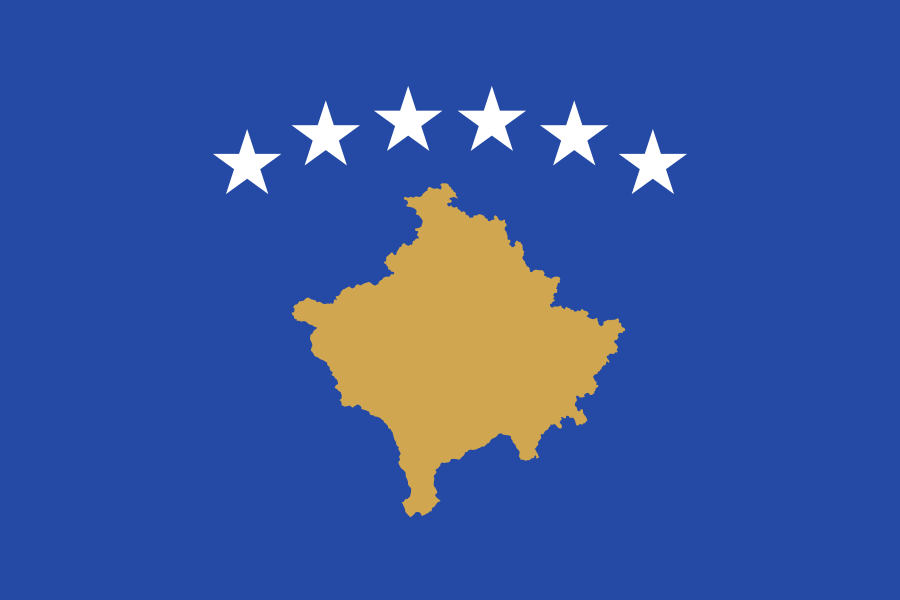
By Andreyyshore – File:Flag of Kosovo.svg, CC BY-SA 3.0, https://commons.wikimedia.org/w/index.php?curid=28393060
Kosovo’s journey towards independence from Serbia was deeply rooted in ethnic and religious differences, with its predominantly ethnic Albanian and Muslim population contrasting sharply with Serbia’s predominantly Serbian and Orthodox Christian demographic. These differences fueled a strong national identity among Kosovar Albanians. The region’s conflict escalated during the Yugoslav Wars, culminating in the Kosovo War (1998–1999), a conflict marked by severe human rights abuses and a humanitarian crisis. The war stemmed from the Serbian government’s oppression of Kosovo’s Albanian majority, who were seeking greater autonomy or independence.
The international community, particularly the United States and European nations, played a pivotal role in resolving the Kosovo conflict. In 1999, NATO intervened with a bombing campaign against Serbia, primarily aimed at stopping the humanitarian crisis and Serbian military activities in Kosovo. This intervention was crucial in ending the conflict and led to the establishment of a United Nations administration in Kosovo. Kosovo declared independence in 2008, but since then, it has faced numerous challenges, including political instability, economic underdevelopment, and high unemployment rates. Over 100 UN member states recognize Kosovo as an independent country. However, its status remains disputed by some countries, including Serbia and several of its allies, affecting Kosovo’s ability to join international bodies like the United Nations and impacting its international relations and economic development.
Catalonia’s Economic Influence and Independence Movement

Catalonia, one of Spain’s most economically dynamic regions, plays a crucial role in the country’s overall financial health. It contributes significantly to Spain’s GDP – around 20% – although it only accounts for around 16% of the country’s population. The region is a hub for manufacturing, services and tourism, making it an important economic powerhouse. However, Catalans feel that the region’s economic contribution in terms of government investment and tax revenues is not equally rewarded. This economic inequality, coupled with a strong sense of their own cultural and linguistic identity, is fueling the drive for independence. Those in favor of secession argue that Catalonia could make more effective use of its economic strengths as an independent state.
Despite these economic and cultural drivers, Catalonia faces major challenges on the road to independence. Migration trends have led to a more demographically diverse population, with many residents from other parts of Spain living and working in Catalonia. This diversity influences public opinion and voting behavior in relation to independence. In addition, legal and political obstacles present significant hurdles. The Spanish government’s opposition, based on constitutional and legal frameworks, makes secession a complex and contentious issue, leading to political stalemates and legal disputes.
Quebec’s Economic Role and Secessionist Aspirations
In Canada, Québec is another example of a region with strong economic and cultural motives to seek greater autonomy or independence. Québec accounts for around 20% of Canada’s GDP and has a diverse economy with strengths in areas such as energy, aerospace and technology. As in Catalonia, efforts to secede in Quebec are not only due to economic factors. The desire of the French-speaking population to preserve and promote their language and culture is an important aspect of the secession movement.
However, the independence movement in Quebec faces a number of challenges. The demographic landscape of the province has been shaped by both internal migration and immigration, which has led to differing views on independence. In addition, the Canadian government’s legal and constitutional framework poses a major challenge to any attempt at secession. The interplay of these economic, cultural, legal and demographic factors continues to influence the feasibility and potential success of Quebec’s quest for greater autonomy or independence.
Social and Cultural Implications
Identity and Cohesion in New Geopolitical Realities
Secession and independence have far-reaching social and cultural implications as they reshape societies within new geopolitical contexts. When regions or entities assert their sovereignty or pursue independent statehood, it leads to a reconfiguration of identities and a redefinition of social cohesion among affected communities.
Formation of Identity: Secession and independence movements often arise from a desire to protect or promote a distinct cultural, ethnic, or national identity. Successful movements can result in the emergence of new nations or autonomous regions, fostering a renewed sense of identity. Asserting sovereignty or achieving independence allows individuals to reaffirm their cultural heritage, language, traditions, and values. It enables a heightened sense of belonging and pride within the population.
Redefining Boundaries: Establishing new political entities through secession or independence entails redefining territorial boundaries. As communities are situated within a different geopolitical framework, they experience significant social and cultural implications. Individuals may need to adjust their sense of belonging and adapt to new political, administrative, and legal structures. Redrawn boundaries can also affect minority groups within the newly formed entity, raising questions about their rights, representation, and integration.
Nation-Building: Secession and independence often require the process of nation-building, involving the construction of a collective national identity, the establishment of institutions, and the fostering of social cohesion. This process entails developing shared values, symbols, and narratives that unify the newly independent or seceded entity. Nation-building may also involve addressing historical grievances, reconciling diverse perspectives, and promoting inclusivity to forge unity and a common purpose.
Intergroup Relations: Secession and independence can strain intergroup relations, particularly when they involve ethno-national or ethno-linguistic divisions. These movements can exacerbate existing tensions or create new fault lines within societies. Managing diversity, promoting dialogue, and safeguarding minority rights become crucial in fostering inclusive and harmonious relationships among groups within the newly formed or seceded entity.
Global Stage Reactions
International Relations and Recognition
The international community’s response to secession and independence movements plays a critical role in shaping the trajectory of newly formed entities. It involves whether these new political actors are embraced or rejected globally and seek recognition from other nations.
Diplomatic Recognition: Recognizing a newly seceded or independent entity as a sovereign state by other countries is a significant factor in establishing its legitimacy and international standing. Diplomatic recognition indicates the willingness of other nations to engage in official relations with the newly formed entity, which can have implications for trade, diplomacy, and participation in international organizations.
Regional and International Organizations: The reaction of regional and international organizations, such as the United Nations and regional blocs, is pivotal in determining the legitimacy and acceptance of new entities. Membership in these organizations can provide international legitimacy, create platforms for diplomatic engagement, and facilitate access to resources and assistance.
Bilateral Relations: The stance of individual countries toward secession or independence movements can vary based on geopolitical interests, historical ties, and legal considerations. Some countries may be supportive and quick to recognize new entities. In contrast, others may approach the situation cautiously or even oppose it, fearing that recognition could set a precedent for secessionist movements within their borders.
Legal Grounds and International Law
Rights and Wrongs: The Legality of New Sovereignties
Determining the legality of secession and establishing new sovereign entities involves navigating complex legal frameworks and principles of international law. Assessing the rights and wrongs in these situations requires legal interpretation and an examination of the specific circumstances.
Self-Determination: The principle of self-determination, recognized in international law, acknowledges the right of people to freely determine their political status and pursue economic, social, and cultural development. The exercise of self-determination can provide a legal basis for secession or the pursuit of independence, particularly when a distinct population seeks to assert its right to self-governance.
Constitutional and Legal Frameworks: The legality of secession often depends on the constitutional and legal frameworks of the parent state. In some cases, existing legal and political structures may provide avenues for peaceful secession or negotiations for independence. However, in other cases, secession may be prohibited or tightly regulated, posing challenges for those seeking to establish new sovereign entities.
International Recognition: Other states’ recognition of new entities can contribute to their legal legitimacy under international law. While recognition is not a prerequisite for statehood, it can strengthen the argument for the legality of secession or independence.
Voices and Narratives
The personal stories and firsthand experiences of individuals engaged in secession and independence movements hold immense significance in shaping novel historical narratives. These individual accounts provide valuable insights into the motivations, challenges, and aspirations of those actively pursuing self-determination.
Individual Experiences: Personal narratives offer a window into the lived experiences of individuals within communities seeking secession or independence. These stories encapsulate the emotions, sacrifices, and resilience demonstrated by those directly shaping their destinies. They bring a human perspective to the more significant political and social dynamics.
Impact on Historical Narratives: The personal experiences of individuals participating in secession and independence movements contribute to fresh historical narratives. These narratives challenge existing accounts and offer alternative viewpoints on the events and circumstances leading to the emergence of such movements. They emphasize the diverse voices and motivations driving the desire for self-governance.
Theoretical and Ethical Considerations
Philosophical Discourses on Self-Governance and Division:
Secession and independence movements give rise to profound philosophical debates concerning self-governance and the legitimacy of state division. Ethical deliberations arise regarding the rights of communities to determine their political status and the justifiability of pursuing independence in specific contexts. These discussions delve into concepts such as autonomy, sovereignty, and principles of justice.
Ethical and Theoretical Foundations of State Fragmentation:
Various ethical frameworks and theories inform discussions surrounding the division of states. Utilitarian perspectives weigh affected populations’ overall well-being and happiness, while deontological approaches examine the principles and obligations involved. Theories encompassing nationalism, multiculturalism, and cosmopolitanism provide diverse perspectives on the ethical implications of secession and independence.
Prospects and Predictions
Analyzing Trends in Secession: Cultural Identities, Political Movements, and Global Influences
Regional identities is often a central element of secessionist movements. Communities with a strong cultural, linguistic or historical identity may feel marginalized in the broader national context, especially if they feel their unique characteristics are underrepresented or threatened. This distinctiveness, rooted in shared history, language, traditions or cultural practices, sets these communities apart from others. When these identities are threatened due to political decisions, cultural assimilation measures or external threats, this can lead to an exacerbation of cultural tensions and a desire to preserve and promote one’s heritage. This desire can extend to seeking greater autonomy or even complete independence in order to protect their cultural integrity.
In response to cultural and identity concerns, political movements often emerge that advocate for greater regional autonomy. These movements can vary in their approach, ranging from peaceful political activism to more radical methods, depending on the level of perceived threat or marginalization. They seek greater local control over cultural, linguistic and educational policies and sometimes even fiscal and political decisions. The aim is to preserve, respect and represent regional identity in the national discourse to reflect the unique needs and aspirations of the community.
Demographic changes have a significant impact on the dynamics of secessionist aspirations. Migration, both internal and international, can change the demographic composition of a region, introducing new cultural elements and potentially diluting existing regional identity. These changes can shift perspectives within the region and influence collective attitudes and voting behavior. The influx of people from different backgrounds can lead to a range of outcomes, from increased cultural integration to heightened tensions and a heightened sense of regional identity. The response to demographic change is complex and affects the direction of political movements and the general mood for autonomy or independence in the region.
Global dynamics, particularly international support and opposition play a critical role in the success of independence movements, often determining their viability and legitimacy. Support from foreign governments, international organizations, and global public opinion can provide essential backing, offering diplomatic recognition, economic assistance, and sometimes even military aid, all of which can bolster the movement’s legitimacy and chances of success. On the other hand, opposition from influential international actors can hinder these movements through diplomatic isolation, economic sanctions, and negative media portrayal, undermining their legitimacy and resource base.
In addition, socio-economic inequalities, especially when regions with strong economies perceive an imbalance in fiscal contributions and benefits, can fuel the desire for greater fiscal autonomy or complete independence. Cultural and economic factors often prove to be the strongest drivers that trigger the movements and shape their future. Understanding these complex and interrelated factors is critical to predicting and understanding the development and potential outcomes of secessionist movements worldwide.
Predicting Paths Towards Autonomy and Independence
Predicting future scenarios for secession and independence movements requires a detailed analysis of various factors, including domestic support, government responses, international norms, and the wider geopolitical landscape. This analysis can lead to several possible outcomes:
Peaceful negotiations and settlements: In some cases, secession movements may lead to peaceful negotiations between the breakaway region and the central government. This scenario is more likely if there is significant internal support, a democratic governance structure, and international support for a peaceful resolution. Successful negotiations may lead to greater autonomy within the existing state or even the peaceful establishment of a new state.
Recognition of new states: For movements with strong internal support and favorable international conditions, there is the possibility of achieving full independence and international recognition. This scenario depends heavily on the geopolitical climate, including support from major powers and international organizations.
Lengthy Conflicts and unresolved disputes: In scenarios where there is significant opposition from the central government, a lack of international consensus or deep internal divisions, secession movements can lead to protracted conflicts. These conflicts can be violent or take the form of protracted political and diplomatic disputes, often with significant humanitarian costs and regional instability.
Continued Push for autonomy: In some cases, secessionist movements do not achieve full independence, but continue to push for greater autonomy and recognition of their cultural, linguistic or political rights within the existing state framework.
Global geopolitical shifts: The international community’s response to one secessionist movement can influence others and lead to shifts in global geopolitics. Support for one movement may encourage others, while failure or strong opposition may discourage similar efforts elsewhere.
Summary: A Complex Interplay
Interconnecting the Strands of Secession and Independence
The realm of secession and independence is a complex interplay of various elements that shape the landscape of self-determination movements. This summary encapsulates the intricate nature of these aspirations and the diverse factors that contribute to their emergence and evolution.
Many motivations drive secession and independence movements, ranging from cultural and ethnic identities to political and economic grievances. The personal experiences and narratives of individuals involved in these movements provide valuable insights into their motivations, challenges, and aspirations. These individual stories humanize the broader dynamics and contribute to forming new historical narratives.
Theoretical and ethical perspectives further enrich our understanding of secession and independence. Philosophical debates revolve around self-governance, division, and the legitimacy of state fragmentation. Ethical considerations delve into the rights of communities to determine their political status and the ethical implications of pursuing independence. Various ethical frameworks and theories inform these discussions, offering diverse lenses to analyze the intricate dynamics of state division.
FAQs: Navigating Common Inquiries
1. How Do Secession and Independence Differ Legally?
Secession and independence differ legally in terms of their recognition and legitimacy. Secession generally refers to a region or territory breaking away from an existing state without the central government’s consent. It is often considered illegal under international law unless it occurs in exceptional circumstances, such as gross human rights violations or a denial of self-determination. On the other hand, independence typically follows a negotiated process or is granted by the central government, creating a new sovereign state recognized by the international community.
2. What Drives Regions to Seek Secession or Independence?
Regions are driven to seek secession or independence due to various factors. Cultural, ethnic, or religious differences, political grievances, economic disparities, and historical injustices can all contribute to the desire for self-determination. The specific motivations vary depending on each region’s context and unique circumstances.
3. How Is New Statehood Gained and Recognized Internationally?
The process of gaining new statehood and international recognition can be complex. Generally, it involves a combination of factors, including a declaration of independence by the aspiring region, the establishment of effective governance structures, the ability to maintain peace and security, and diplomatic efforts to gain recognition from other states.
4. What Are the Potential Outcomes for Newly Formed or Divided Regions?
The potential outcomes for newly formed or divided regions can vary widely. In some cases, peaceful negotiations can lead to the recognition of a new sovereign state, allowing it to participate in international affairs. Protracted and unresolved disputes may arise, resulting in ongoing tensions and instability. There can also be situations where regions achieve a degree of autonomy within an existing state without gaining complete independence. The outcomes depend on the specific circumstances, the responses of central governments and the international community, and the ability to establish functioning governance structures.


